🚃 KANSAI TRAIN GUIDE · PART 3
Kansai’s Trains Explained: Every Railway & Limited Express in 7 Prefectures
Shiga, Nara, Kyoto, Osaka, Hyogo, Wakayama & Mie – where each train takes you, what it costs, and which stations are handy.
In Part 2, I showed you how to reach 10 great spots from Kansai Airport. But Kansai’s railways go far beyond those spots! In this Part 3, we zoom out and meet every kind of train you can ride across the seven Kansai prefectures: Shiga, Nara, Kyoto, Osaka, Hyogo, Wakayama and Mie.
For each railway, I’ll tell you what kind of sightseeing it suits, roughly what it costs, how busy it gets, and which stations are the most convenient. At the very end, I’ll also give you a little sneak peek of my next topic: how the character of a neighborhood is often linked to the train line that serves it.
📖 Read Part 2: The Easy Train & Bus Guide from the Airport
💡 Key Point
Fares are approximate and based on information available in 2026. Many railway companies have raised or are revising their fares, so please check the latest price on the official website or a navigation app. The ridership stars (★) are my own rough impression based on general ridership information, not official statistics.
🧭 How to Read This Guide
I use the same simple labels everywhere, so you can compare railways quickly:
- 🎯 Great for – the kind of sightseeing the line suits
- 💴 Fare – a typical one-way adult fare (approximate)
- 👥 Ridership – ★★★★★ = among the busiest in Japan, ★★★★ = very busy, ★★★ = busy, ★★ = moderate, ★ = quiet and local
- 📍 Handy stations – the stations where you can easily transfer or reach major sights
🗺️ Where Do the Railways Run?
Before we meet the railways one by one, here’s a simple picture of roughly where each one runs. You don’t need to know any station names. Just look at the colored lines to get a feel for each railway’s territory.
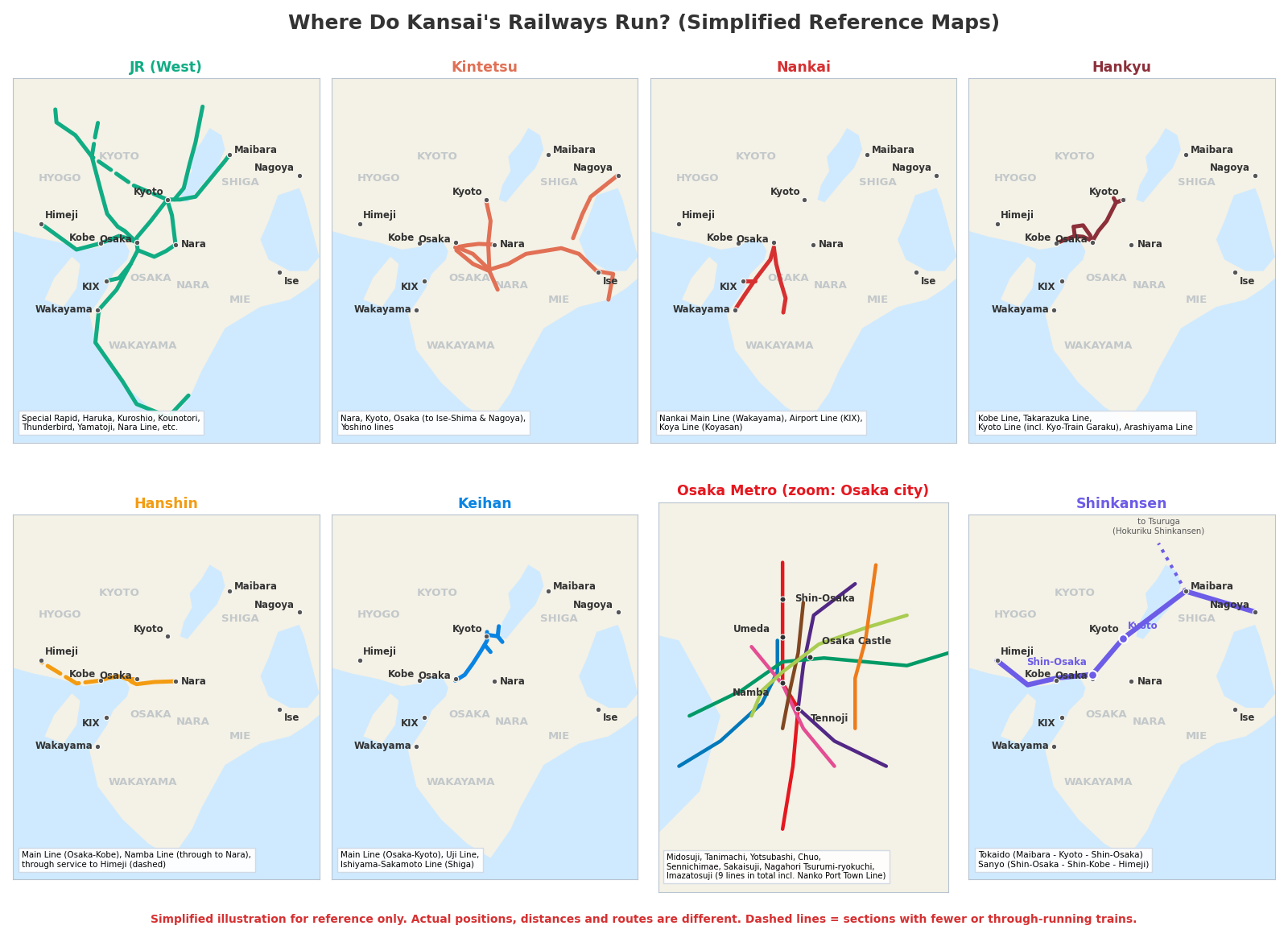
⚠️ These maps are for reference only. They are simplified illustrations that show roughly where each railway runs. The actual positions, distances and routes are different. Please check a navigation app before you travel.
🚆 Meet the Railway Companies
Kansai is a railway lover’s paradise, with many companies competing for the same passengers. Here are the main players.
🟩 JR West
The Biggest Network
JR West connects all the big cities and runs famous trains like the Special Rapid, Haruka, Kuroshio, Kounotori and Thunderbird. It also runs the Osaka Loop Line and the Sanyo Shinkansen.
- 🎯 Great for: Kyoto, Kobe, Himeji, Nara, Wakayama, Kinosaki Onsen, Universal Studios Japan
- 💴 Fare: Osaka–Kyoto approx. ¥580; Osaka–Sannomiya approx. ¥410–460; Osaka–Himeji approx. ¥1,500–1,700
- 👥 Ridership: ★★★★★ (the largest network; Osaka Station is one of Japan’s busiest)
- 📍 Handy stations: Osaka, Shin-Osaka, Kyoto, Sannomiya
🟨 Kintetsu
Japan’s Longest Private Railway
Kintetsu links Osaka, Kyoto, Nara, Mie and Nagoya. It is known for its stylish limited expresses: Hinotori, Shimakaze, Ise-Shima Liner and Urban Liner.
- 🎯 Great for: Nara, Ise-Shima (Ise Jingu, Toba), Mt. Yoshino, Nagoya
- 💴 Fare: Namba–Nara approx. ¥700; Namba–Toba base fare approx. ¥2,040 plus a limited express fee; Namba–Nagoya on Hinotori approx. ¥4,990
- 👥 Ridership: ★★★
- 📍 Handy stations: Osaka-Namba, Osaka-Uehonmachi, Tsuruhashi, Kintetsu-Nara, Kyoto, Nagoya
🟥 Nankai
Namba to the Airport and Mt. Koya
Nankai runs from the Namba terminal to Kansai Airport, Wakayama and the sacred mountain of Koyasan.
- 🎯 Great for: Kansai Airport, Dotonbori, Wakayama, Koyasan
- 💴 Fare: Namba–KIX approx. ¥970 (Airport Express) or ¥1,350–1,490 (Rapi:t); Namba–Koyasan approx. ¥1,430 including the cable car, plus approx. ¥1,100 for the Limited Express Koya
- 👥 Ridership: ★★★
- 📍 Handy stations: Namba, Shin-Imamiya, Wakayamashi
🟨 Hankyu
The Elegant Maroon Trains
Hankyu’s maroon trains are famous for their refined interiors. They run from Umeda to Kyoto, Kobe and Takarazuka.
✨ Kyo-Train Garaku: A Special Treat at the Regular Fare
On the Hankyu Kyoto Line, you may also meet the Kyo-Train Garaku, a special train inspired by Kyoto. Its interior is more beautiful than a regular Hankyu train, and the seating is roomy, so you can relax and enjoy the ride.
Best of all, there’s no extra fee. You pay the same fare as a regular Hankyu train. It doesn’t run every day, so please check the Hankyu timetable if you’d like to ride it.
- 🎯 Great for: Kyoto’s Kawaramachi and Arashiyama, Kobe-Sannomiya, Takarazuka, Ikeda (Cup Noodles Museum), Minoo
- 💴 Fare: Umeda–Kyoto-Kawaramachi approx. ¥410–430 (the same on Kyo-Train Garaku); Umeda–Kobe-Sannomiya approx. ¥330
- 👥 Ridership: ★★★★
- 📍 Handy stations: Osaka-Umeda, Juso (transfer), Katsura (for Arashiyama), Kyoto-Kawaramachi, Kobe-Sannomiya, Takarazuka, Nishinomiya-Kitaguchi
🟨 Hanshin
Osaka to Kobe, Home of the Tigers
Hanshin runs along the coast between Osaka and Kobe. It serves Koshien Stadium, home of the Hanshin Tigers baseball team, and its Namba Line has through trains to Kintetsu-Nara.
- 🎯 Great for: Koshien baseball games, Mikage (Mt. Rokko), Kobe’s Motomachi and Chinatown, direct rides from Namba to Nara
- 💴 Fare: Umeda–Kobe-Sannomiya approx. ¥330
- 👥 Ridership: ★★★
- 📍 Handy stations: Osaka-Umeda, Osaka-Namba, Koshien, Kobe-Sannomiya, Motomachi
🟨 Keihan
Osaka to Kyoto, Right at the Sights
Keihan connects Osaka and Kyoto along the Yodo River, and its Kyoto stations are right next to famous temples and shrines.
- 🎯 Great for: Fushimi Inari, Kiyomizu-dera, Sanjusangen-do, Gion, Uji (Byodo-in), Ishiyama-dera in Shiga
- 💴 Fare: Yodoyabashi–Gion-Shijo approx. ¥430–470
- 👥 Ridership: ★★★
- 📍 Handy stations: Yodoyabashi, Kyobashi, Fushimi-Inari, Kiyomizu-Gojo, Gion-Shijo, Sanjo, Demachiyanagi, Chushojima
🟨 Subways
Osaka, Kyoto & Kobe City Transit
Osaka Metro has nine lines, and the red Midosuji Line is the main artery connecting Shin-Osaka, Umeda, Namba and Tennoji. Kyoto has two subway lines (Karasuma and Tozai), and Kobe has a subway plus the driverless Port Liner.
- 🎯 Great for: getting around inside each city, Osaka Castle, Dotonbori, Nijo Castle, Kobe Harborland
- 💴 Fare: Osaka Metro from approx. ¥180 (Umeda–Namba approx. ¥240); Kyoto and Kobe subways from approx. ¥220
- 👥 Ridership: Osaka Metro ★★★★★ (Midosuji Line is the busiest), Kyoto ★★★, Kobe ★★★
- 📍 Handy stations: Umeda, Shin-Osaka, Namba, Tennoji, Honmachi, Kyoto Station, Karasuma-Oike, Sannomiya
🚅 Shinkansen
The Bullet Trains
The Tokaido Shinkansen (operated by JR Central) stops at Maibara in Shiga, Kyoto and Shin-Osaka. The Sanyo Shinkansen (operated by JR West) continues west to Shin-Kobe, Nishi-Akashi and Himeji. The fastest trains are the Nozomi (Tokaido) and the Mizuho and Sakura (Sanyo), while Hikari and Kodama stop more often. The Hokuriku Shinkansen currently ends at Tsuruga in Fukui, where passengers connect to the Thunderbird limited express for Kyoto and Osaka.
Even so, most people who live in Kansai use Shin-Osaka or Kyoto when they take the Shinkansen. Those two stations are all you really need to remember.
- 🎯 Great for: long-distance travel to Tokyo and Hiroshima, quick hops between Kyoto, Osaka and Himeji
- 💴 Fare: Shin-Osaka–Kyoto approx. ¥1,500–1,800 (about 15 minutes); Tokyo–Shin-Osaka approx. ¥14,000–15,000
- 👥 Ridership: ★★★★★ at Kyoto and Shin-Osaka
- 📍 Handy stations: Shin-Osaka, Kyoto
🚋 Local & Scenic Lines
Small Railways with Big Charm
Don’t skip the small lines! Kyoto has the Eizan Electric Railway (to Kurama and Kibune), the Randen tram and the Sagano Scenic Railway. Osaka has the retro Hankai Tramway, Wakayama has the Kishigawa Line with its themed trains, and Mie has the Iga Railway. Hyogo’s Shintetsu and Sanyo Electric Railway connect Kobe and Himeji with mountain and coastal towns.
- 🎯 Great for: mountain temples, retro rides, themed trains, quieter sightseeing
- 💴 Fare: short rides are usually approx. ¥200–500
- 👥 Ridership: ★–★★
🌟 The Limited Express Hall of Fame
Limited expresses are the stars of Kansai’s rail network. They are faster, and many have comfortable reserved seats.
💡 Key Point
Not every “limited express” costs extra! On JR, Kintetsu and Nankai, you pay a limited express fee on top of the base fare. But on Hankyu, Hanshin and Keihan, the “limited express” is just a fast regular train with no extra charge (Keihan’s Premium Car is the exception). Hankyu’s special Kyo-Train Garaku is also available at the regular fare, with no extra fee.
🗾 Prefecture-by-Prefecture Guide
Now let’s go through the seven prefectures one by one. Fares are typical one-way adult fares.
🌊 Shiga: Lake Biwa Country
Shiga is home to Japan’s largest lake and is just minutes from Kyoto by train. It’s quieter than the big cities, with castles, old towns and lake views.
📍 Handy stations: Maibara (Shinkansen hub), Hikone, Omi-Hachiman, Otsu, Kusatsu, Nagahama
🦌 Nara: The Ancient Capital
Nara is compact and easy by train. Most visitors use Kintetsu, which drops you right next to the park.
📍 Handy stations: Kintetsu-Nara (a short walk to Nara Park), JR Nara, Yamato-Saidaiji (transfer hub), Nishinokyo, Horyuji, Yoshino
⛩️ Kyoto: Temples, Shrines & Tradition
Kyoto’s subway is small, so sightseeing here is a mix of JR, Keihan, Hankyu and buses. Choose the line that’s closest to your sight.
📍 Handy stations: Kyoto Station (JR, subway, Kintetsu and Shinkansen), Gion-Shijo (Keihan), Kawaramachi (Hankyu), Karasuma-Oike (subway interchange), Saga-Arashiyama, Inari, Demachiyanagi
🍢 Osaka: The Big City Hub
Osaka has the densest rail network in Kansai. It’s a hub for the whole region, so most trips pass through here.
📍 Handy stations: Umeda area (Osaka Station and Osaka-Umeda), Shin-Osaka (Shinkansen), Namba (Nankai, Kintetsu, Midosuji Line), Tennoji, Tsuruhashi, Kyobashi, Honmachi (subway transfer), Nishikujo (for Universal Studios Japan)
🏯 Hyogo: Port Cities, Castles & Hot Springs
Hyogo is long and varied. Three railways (JR, Hankyu and Hanshin) run side by side between Osaka and Kobe, so you can choose by price, speed or style.
📍 Handy stations: Sannomiya (three railway stations, a subway, the Port Liner and the bus terminal), Kobe, Shin-Kobe, Himeji, Koshien, Mikage, Motomachi, Takarazuka, Akashi, Kinosaki Onsen
⛰️ Wakayama: Sacred Mountains & Beaches
Wakayama is beautiful but far from the big cities, so the train is a big part of the journey. Take your time!
📍 Handy stations: Wakayama (JR), Wakayamashi (Nankai), Shirahama, Kii-Tanabe, Kii-Katsuura, Hashimoto, Gokurakubashi (for Koyasan)
⛩️ Mie: Ise Jingu & the Sea
Mie is the home of Ise Jingu, Japan’s most sacred shrine. Kintetsu is the star here, and you can ride in style on a luxury sightseeing train.
📍 Handy stations: Ise-shi and Ujiyamada (for Ise Jingu), Toba, Kashikojima, Matsusaka (famous for beef), Tsu, Kuwana, Kintetsu-Yokkaichi, Iga-Ueno
🎯 Which Train for Which Trip?
Not sure where to start? Match your travel style to the best railway.
🔍 Sneak Peek: Trains and Neighborhood Vibes
Here’s something interesting I noticed: in Kansai, the railway line running through a neighborhood often shapes how that neighborhood feels. This is a topic I’d like to explore in depth in my next post, Kansai’s safety and area atmosphere. Here’s a quick preview.
🗒️ A Quick Overview
- ✅ Hyogo: The Hankyu line between Osaka and Kobe has a refined, upscale image, with quiet residential towns. The Hanshin line, by contrast, is generally seen as more down-to-earth and lively, with a stronger working-class character. Both lines serve nice neighborhoods, so these are only general impressions.
- ✅ Osaka (north): The Hokusetsu area in the north is generally known for its calm, family-friendly and safe atmosphere.
- ✅ Osaka (south): The south has bigger contrasts. Nishinari has a reputation as one of the roughest areas in Osaka, and caution is advised there, especially at night. Yet right in the same southern part of the city, Tezukayama is a well-known high-class residential neighborhood.
⚠️ Good to Know: These are general impressions, not official statistics. Kansai is generally safe for travelers, like the rest of Japan, and most visitors have no problems. A neighborhood’s reputation doesn’t tell you how safe a particular street is at a particular time. In the next post, I’ll look at each area in more detail.
⚠️ Good to Know: Please Read Before You Go
Routes, fares and timetables change often. Please check the latest information on the official websites or a navigation app before you travel, and choose the railway that suits your plans, budget and comfort level.
💬 Have a Question?
If anything about Kansai’s trains is unclear, please send me a message from the “Contact” page. I’ll do my best to answer!
Thank You for Reading! 🚃🌸
Now you know Kansai’s trains, from famous limited expresses to tiny local lines. Next, let’s learn about the places themselves!
🔍 Next Up: Kansai’s Safety & Area Atmosphere
In my next post, I’ll introduce which neighborhoods feel upscale, which feel lively, and where to be more careful, across Kansai’s train lines and cities. If you’re choosing where to stay or live, don’t miss it!