🚆 KANSAI TRANSPORT GUIDE · PART 2
Getting Around Kansai: The Easy Train & Bus Guide from the Airport
How to reach all 10 spots from KIX – plus every train, bus and boat worth knowing.
In Part 1, I shared 10 Kansai spots I truly love. Now comes the question every traveler asks next: “How do I actually get there?” At first, Kansai’s rail map can look like a bowl of noodles, with many companies, colors and train names. But don’t worry! Once you know a few basics, it’s easy – and even fun.
This guide follows the same order as Part 1 (Kyoto, Osaka, Nara, Hyogo) and starts from Kansai International Airport (KIX). After the routes, I’ll also introduce the other kinds of trains and transport you’ll meet in Kansai, so you can ride like a local.
📖 Read Part 1: 10 Kansai Spots I Truly Love
💡 Key Point
Fares and travel times in this article are approximate and based on information available in spring 2026. Fares, timetables and visitor discounts change often, so please double-check on the official websites or a navigation app before you go.
- 🗺️ The Big Picture
- 🎫 3 Things to Prepare Before You Ride
- ✈️ Step 1: Leaving the Airport
- ⛩️ Kyoto Prefecture
- 🍢 Osaka Prefecture
- 🦌 Nara Prefecture
- 🏯 Hyogo Prefecture
- 🚃 Beyond the Routes: Kansai's Train Types
- 🚉 Meet the Railway Companies
- 🧰 More Ways to Get Around
- 🎟️ What About Passes?
- 🎒 Ride Like a Local: Quick Tips
- 📋 Quick Reference (From KIX)
🗺️ The Big Picture
Here’s a simple map to give you a rough idea of how the places are connected. Kansai International Airport sits on an island in Osaka Bay, and from there, trains, buses and even a boat lead to the spots in this series.
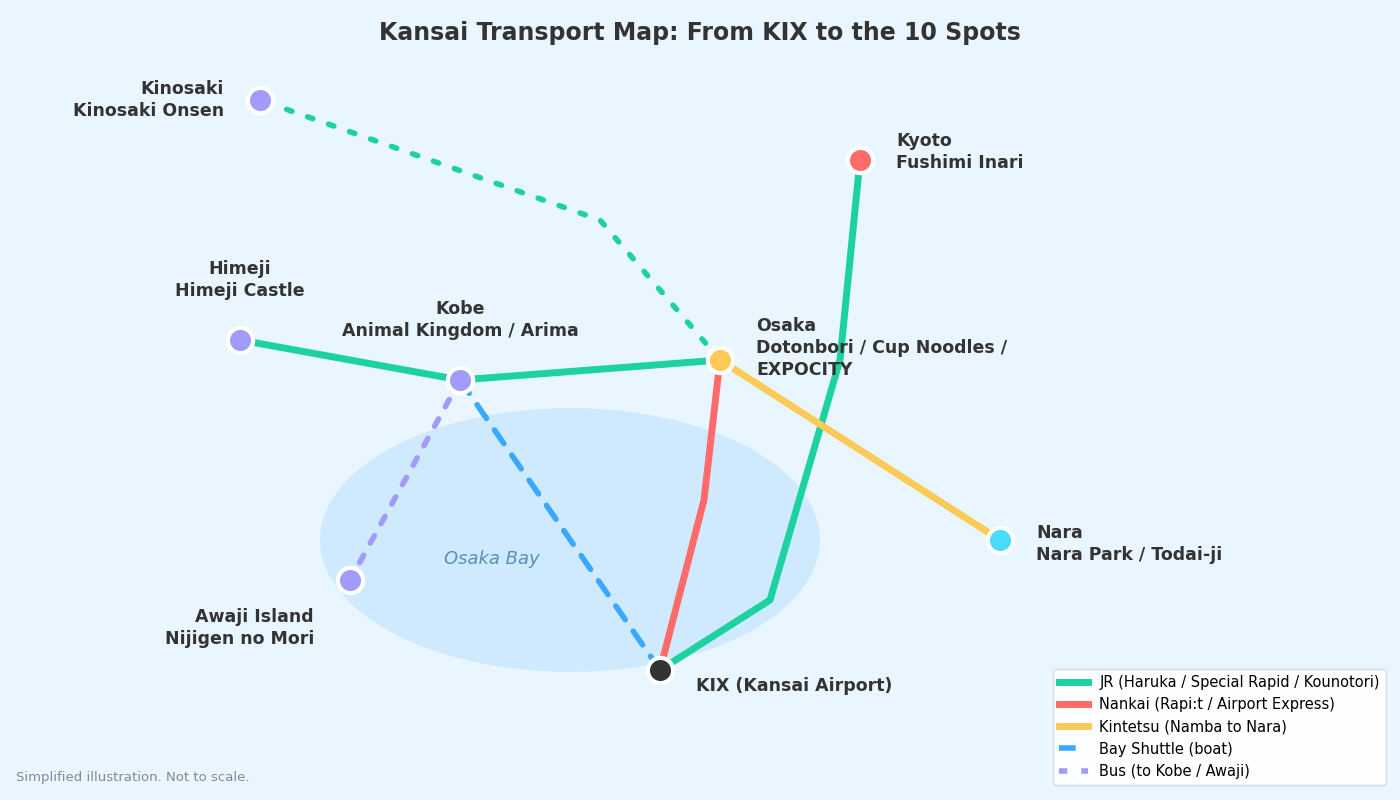
⚠️ This map is for reference only. It shows just the rough positional relationship between the places. The actual locations, distances and routes are different. Please research each route carefully before you go.
🟩 JR trains
🟥 Nankai trains
🟨 Other private railways, subway & monorail
🟪 Buses
🟦 Boat
⬜ Walking
The route cards below use these colors, so you can see at a glance which company runs each ride.
🎫 3 Things to Prepare Before You Ride
- ✅ An IC card. You just tap in and tap out. It works on JR, subways, private railways, buses and even in convenience stores. ICOCA is Kansai’s card, but Suica, PASMO and other IC cards work too. Physical cards have been in limited supply at times, so check availability in advance, or use a mobile IC card on your smartphone.
- ✅ A navigation app. Google Maps or a Japanese train app shows platform numbers, transfers and fares in real time. Honestly, it’s the best travel buddy in Kansai.
- ✅ A visitor Haruka ticket (if you’re eligible). JR West offers a discounted smartphone QR ticket for the Haruka to visitors with a foreign passport (around ¥2,200 to Kyoto at the time of writing). Buy it before you fly. Rules and prices can change, so check the JR West website.
✈️ Step 1: Leaving the Airport
Kansai Airport Station is connected to the 2nd floor of Terminal 1. Two railway companies run from here: JR and Nankai. If you land at Terminal 2 (the low-cost terminal), take the free shuttle bus to Terminal 1 first, which takes about 10 minutes.
💡 Key Point
Haruka and Rapi:t are “limited express” trains with an extra seat fee. The Nankai Airport Express and the JR Kanku Rapid are regular trains that don’t need a reservation, and they cost less. Traveling with a big suitcase? A limousine bus stores your bags under the floor, and that’s a big relief.
⛩️ Kyoto Prefecture
No. 1
Fushimi Inari Taisha
🚄 Haruka · 75–80 min ➜
Kyoto Stn ➜
🚃 JR Nara Line · 5 min ➜
Inari Stn ➜
🚶 1 min ➜ ⛩️
The Haruka takes you straight from the airport to Kyoto Station with no transfer. Then hop on the JR Nara Line to Inari Station, which is right in front of the shrine. Only local trains stop at Inari, and rapid trains skip it, so check the sign before you board. Another option is the Keihan Line, which has its own Fushimi-Inari Station nearby.
🍢 Osaka Prefecture
No. 2
Dotonbori
🚃 Airport Express · 45 min
(or 🚀 Rapi:t · 35–40 min) ➜
Nankai Namba Stn ➜
🚶 5–10 min ➜ 🍢
This is the easiest route of all. Nankai trains run directly from the airport to Namba Station, and Dotonbori is a short walk away. The Airport Express is a regular train with no reservation needed, and it’s the budget pick. The Rapi:t is a reserved-seat limited express with a futuristic look, and it’s faster and more comfortable. Namba Station is big, so follow the signs for Dotonbori.
No. 3
Cup Noodles Museum Osaka Ikeda
🚃 Nankai · 40–45 min ➜
Namba ➜
🚇 Midosuji Line · ~8 min ➜
Umeda ➜
🚃 Hankyu Takarazuka Line · 20–25 min ➜
Ikeda Stn ➜
🚶 5 min ➜ 🍜
Ikeda is a quiet residential city just north of Osaka, and the museum is a short walk from the station. Take the Hankyu Takarazuka Line from Umeda and look for a train that stops at Ikeda. Shortcut: if you take the JR Haruka to Osaka Station instead, you can walk to Hankyu Umeda Station and skip the subway.
No. 4
LaLaport EXPOCITY
🚃 Nankai · 40–45 min ➜
Namba ➜
🚇 Midosuji Line · ~8 min ➜
Umeda ➜
🚃 Hankyu Takarazuka Line to Hotarugaike ➜
🚝 Osaka Monorail ➜
Banpaku-kinen-koen Stn ➜
🚶 short walk ➜ 🎡
This is the trickiest route in this guide because it has several transfers, and the monorail is the final leg. The stop you want is Banpaku-kinen-koen Station (“Expo Commemoration Park”). Use a navigation app to pick the best transfer for your time of day. The monorail itself is a fun ride, with a great view from above the city.
🦌 Nara Prefecture
No. 5
Nara Park & Todai-ji Temple
🚃 Nankai · 45 min ➜
Namba ➜
🚶 to Kintetsu Namba ➜
🚃 Kintetsu Rapid Express · ~40 min ➜
Kintetsu-Nara Stn ➜
🚶 5–20 min ➜ 🦌
In Namba, Nankai and Kintetsu stations are right next to each other, so the transfer is easy. Kintetsu-Nara Station is close to the park, and you’ll meet the first deer within minutes. Todai-ji Temple is about a 20-minute walk from the station, or you can take a local bus. JR alternative: if you’re using JR passes, go from KIX to Tennoji, then take the JR Yamatoji Rapid to JR Nara Station (a longer walk to the park).
🏯 Hyogo Prefecture
No. 6
Himeji Castle
🚄 Haruka · ~50 min
(or Kanku Rapid · ~70 min) ➜
Osaka Stn ➜
🚃 JR Special Rapid · ~60 min ➜
Himeji Stn ➜
🚶 15 min ➜ 🏯
The JR Special Rapid Service (called “Shinkaisoku” in Japanese) is a hidden gem. It’s the fastest train you can take without paying any extra fee, and it links Kyoto, Osaka, Kobe and Himeji. From Himeji Station, the castle appears at the end of a long, straight main street, so you can walk there, and the walk itself is part of the fun. Renting a bicycle is another popular option.
No. 7
Kobe Animal Kingdom
⛴️ Bay Shuttle · 30–40 min ➜
Kobe Airport ➜
🚝 Port Liner · 1 stop ➜
Keisan Kagaku Center Stn ➜
🚶 1–3 min ➜ 🐘
This is my favorite route in the whole guide, because you cross Osaka Bay by high-speed boat. At Kobe Airport, the driverless Port Liner monorail takes you just one stop to Keisan Kagaku Center Station, and the zoo is a very short walk away. The Bay Shuttle only runs during the daytime with limited departures, so check the timetable first. Backup plan: take a limousine bus from KIX to Sannomiya (about 65–70 minutes), then the Port Liner. The zoo has regular closing days (often Thursdays), so check its calendar.
No. 8
Arima Onsen
🚌 Limousine Bus · 65–70 min ➜
Sannomiya ➜
🚌 Arima Express Bus · ~30 min ➜ ♨️
Kobe-Sannomiya is the gateway to Arima. From there, an express bus takes you up into the mountains in about 30 minutes, and the bus stop is close to the hot spring town. You can also reach Sannomiya with the Bay Shuttle and Port Liner, or by train with a few transfers. The buses can fill up on weekends and holidays, so leave some time to spare.
No. 9
Kinosaki Onsen
🚄 Haruka or Kanku Rapid · 50–70 min ➜
Osaka Stn ➜
🚄 Limited Express Kounotori · 2 hr 40 min – 3 hr ➜
Kinosaki Onsen Stn ➜
🚶 5–10 min ➜ ♨️
The good news is that the Kounotori limited express runs straight from Osaka to Kinosaki Onsen, so there’s no transfer on the long leg. The bad news is that it’s a long ride and the trains aren’t very frequent, so reserve a seat and check the timetable. Because the trip takes about four hours from the airport, I recommend staying overnight. In winter crab season, hotels and seats fill up early.
No. 10
Nijigen no Mori (Awaji Island)
🚌 Limousine Bus · 65–70 min ➜
Sannomiya Bus Terminal ➜
🚌 Highway Bus over the Akashi Kaikyo Bridge · ~40 min ➜
Awajishima Park bus stop ➜
🚶 short walk ➜ 🎮
Good news: you don’t need a car! A direct highway bus runs from Sannomiya over the Akashi Kaikyo Bridge to a bus stop at Awajishima Park, right by the theme park. Direct highway buses also run from other places such as JR Osaka Station and Shin-Kobe. Please check the timetable and the last bus back in advance, since buses to the island are less frequent than trains. I haven’t visited yet, so this route is based on the park’s official access information.
🚃 Beyond the Routes: Kansai’s Train Types
You’ll notice that trains on the same line have different names, like Local, Express and Rapid. It matters, because riding the wrong one can mean missing your stop or waiting much longer. Here’s the ladder, from slowest to fastest:
💡 Key Point
Names differ by company. For example, a “Rapid Express” on Kintetsu and a “Special Rapid” on JR are not the same thing. The board above the platform shows the train type and destination, and it’s usually shown in English too. Check it before you board, and use your navigation app to see which train stops where.
🚉 Meet the Railway Companies
Kansai has many railway companies, and one city can have several stations with different names. Here are the main ones you’ll meet:
🧰 More Ways to Get Around
Trains aren’t the only fun way to travel in Kansai. Here’s your toolbox:
🚇 Subway
Osaka, Kyoto and Kobe each have one. In Osaka, the Midosuji Line is the main artery.
🚌 City & Highway Buses
Kyoto city buses reach temples that trains don’t. Highway and limousine buses go to the airport, Awaji and more.
⛴️ Boats
The Bay Shuttle links KIX and Kobe Airport, and river cruises run around Dotonbori.
🚝 Monorails & New Transit
Osaka Monorail (to EXPOCITY) and Kobe’s driverless Port Liner are rides in themselves.
🚠 Ropeways & Cable Cars
Kinosaki has a ropeway with a town view, and Kobe’s Mt. Rokko has cable cars and ropeways for night views.
🚅 Shinkansen
The bullet train connects Shin-Osaka and Kyoto in about 15 minutes. Handy when you’re short on time.
🚕 Taxis
Great for late nights, groups and short hops. Taxis from KIX into the city are expensive, so use them only if you must.
🚲 Bikes & Rental Cars
Bicycles are fun in Himeji and Kyoto, and a rental car makes Awaji Island much easier.
🎟️ What About Passes?
Kansai has several money-saving passes, such as JR West’s Kansai area passes (which include the Haruka), the Kintetsu Rail Pass, the Osaka Amazing Pass and one-day subway passes. A pass isn’t always cheaper, though. Add up your planned rides first and compare with paying by IC card. Passes are also renamed, changed or discontinued from time to time, so check the current lineup on each official website.
🎒 Ride Like a Local: Quick Tips
- ✅ Line up at the marks on the platform floor and let people get off first
- ✅ Keep your voice down on trains, and avoid phone calls
- ✅ Avoid rush hours (around 7:30–9:00 and 17:00–19:00) with big suitcases
- ✅ Check the last train time, because many lines stop around midnight
- ✅ Use luggage lockers at stations, or send your suitcase to your hotel with a delivery service
- ✅ Keep enough balance on your IC card, or top it up at any ticket machine
📋 Quick Reference (From KIX)
⚠️ Good to Know: Please Read Before You Go
The map in this article is for reference only. It shows just the rough positional relationship between the places, and the real locations, distances and routes are different. Before you head to any spot, please research the latest route, timetable and fare carefully.
The routes in this guide start from KIX, but they are just some of the many ways to get there. Kansai has a lot of trains, buses and other options, so please choose the way that suits you best, based on your budget, luggage, schedule and comfort level. A route that works well for someone else might not be the best one for you!
💬 Have a Question?
If anything about getting around Kansai is unclear, please send me a message from the “Contact” page. I’ll do my best to answer!
Thank You for Reading! 🚆🌸
I hope this guide helps you enjoy Kansai with confidence. Now you know how to reach the spots, so let’s go one step deeper!
🚃 Next Up: Kansai’s Trains in Detail
In my next post, I’ll introduce the features of Kansai’s trains in detail: what makes each railway company and each train special, and how they differ. If you want to ride like a local, don’t miss it!